
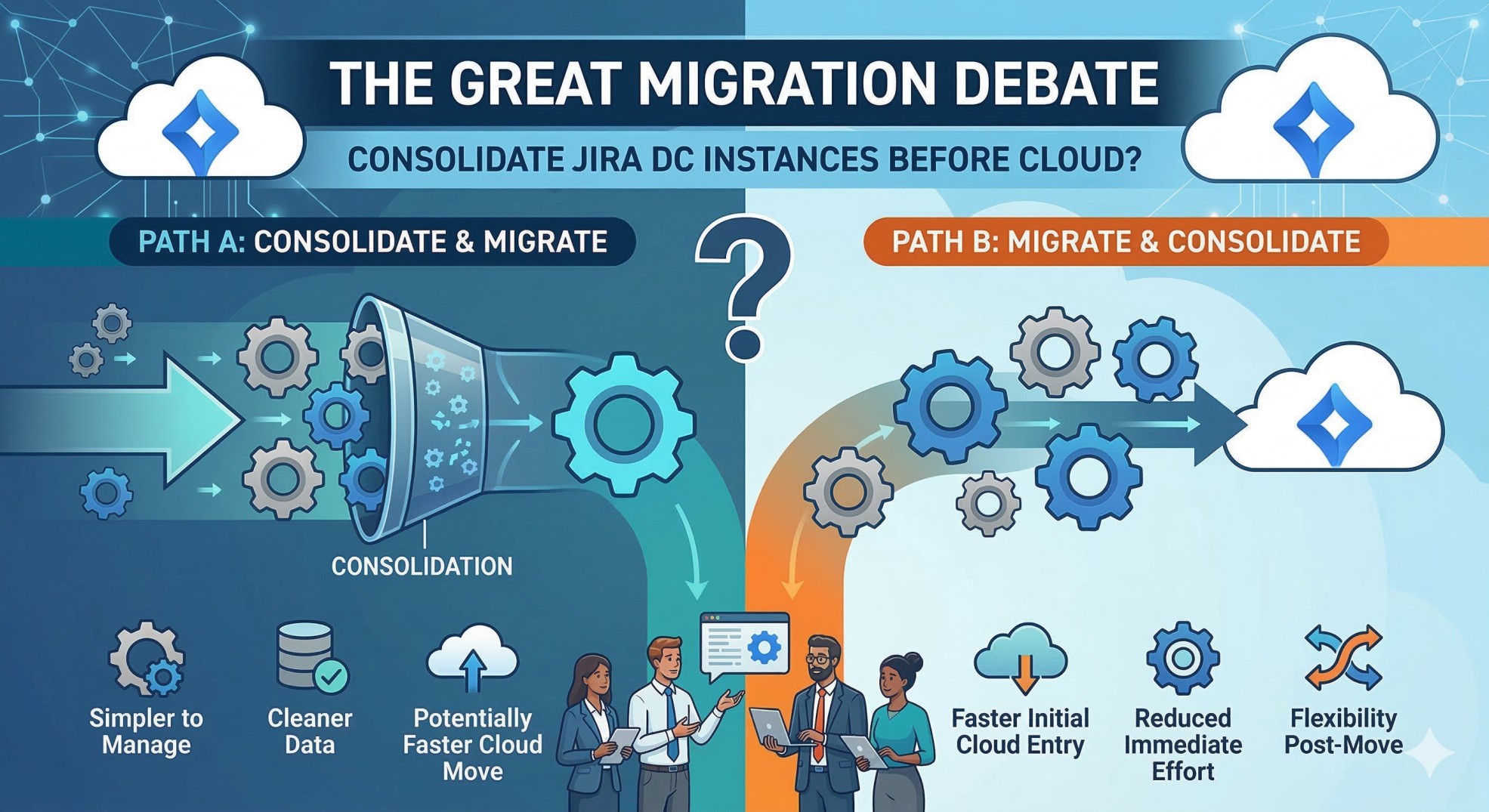
The question of whether to "clean house" by consolidating multiple Jira Data Center (DC) instances before moving to the Cloud, or to simply migrate them as-is and sort out the mess later, is the "move-in" dilemma of the enterprise world.
Think of it like moving from several large suburban houses into a sleek, modern high-rise. Do you hire five different moving trucks to drop everything in the lobby at once, or do you consolidate your belongings into one manageable set of boxes first?
Here is an exploration of the strategic "Consolidate First" vs. "Migrate then Merge" debate.
The Case for Consolidation: "Fixing it at the Source"
Consolidating your Jira DC instances before the big move is often the "Gold Standard" approach, particularly for organizations with high complexity and strict governance.
1. Reducing "Technical Debt" Multipliers
In a Jira Cloud environment, your subscription costs and performance are often tied to user tiers and data volume. If you migrate three separate instances, you are likely migrating triple the redundant custom fields, defunct schemes, and "zombie" projects. Consolidating on-premise allows you to delete the junk where storage is cheap and processing power is within your control, ensuring you don't pay for "digital clutter" in the Cloud.
2. Streamlining Identity Management
One of the biggest hurdles in Cloud migration is Atlassian Access and identity syncing. If Instance A uses one Active Directory and Instance B uses another (or worse, local internal directories), merging them on-premise allows you to resolve username conflicts and email mismatches before they hit the Cloud's strict "one email per user" rule.
3. App Audit and Rationalization
Not every DC app exists in the Cloud, and those that do often function differently. By consolidating first, you can standardize your app usage. Instead of migrating three different time-tracking plugins, you can force a transition to one standard tool on-premise, simplifying the migration path for your data.
The Risks of the "Consolidate First" Strategy
While it sounds logical, consolidation is not a magic bullet. It comes with its own set of "gotchas."
- The "Double Migration" Fatigue: You are essentially asking your teams to undergo two major changes. First, they have to adapt to a new consolidated DC environment, and shortly after, they have to learn the Cloud UI. Change fatigue is real and can kill productivity.
- Version Parity Issues: Merging DC instances often requires them to be on the exact same version of Jira. If Instance A is on 8.5 and Instance B is on 9.4, you have a massive upgrade project on your hands before you even start the consolidation.
The Case for "Migrate then Merge": The Cloud-Native Approach
Increasingly, Atlassian and many Solution Partners are suggesting a different route: Move your instances to the Cloud as separate "tenants" or into a single Cloud site as separate projects, then consolidate within the Cloud environment.
1. Leveraging the Jira Cloud Migration Assistant (JCMA)
The JCMA is a powerful tool designed to move projects individually. It is often easier to "cherry-pick" clean projects from various DC instances and fly them into a single Cloud site one by one than it is to perform a massive database-level merge on-premise.
2. Immediate Access to Cloud Benefits
If your DC instances are failing or slow, waiting 6–12 months to consolidate on-premise delays your access to Cloud-only features like advanced automation, better mobile apps, and integrated AI (Atlassian Intelligence). Sometimes, the business value of getting to the Cloud now outweighs the "cleanliness" of a consolidated instance.
3. Sandboxing and Testing
Cloud Premium and Enterprise tiers offer Sandboxes. You can migrate Instance A to a sandbox, test it, then move it to production. This "staged" approach is often less risky than a "Big Bang" consolidation on-premise where one mistake can take down the whole system.
Decision Matrix: Which Path is Yours?
To help you decide, consider this comparison table:
Factor
Consolidate First
Migrate Then Merge
Complexity
High (Database & Scheme heavy)
Moderate (Tool-assisted)
User Impact
High (Two major changes)
Low (Gradual transition)
Timeline
Longer upfront
Faster initial migration
Cost
High On-Prem labor
Potential "clutter" costs in Cloud
App Support
Standardized before move
Handled on a per-instance basis
The "Middle Ground" Recommendation
For most mid-to-large enterprises, a Hybrid Cleanup is the most effective route.
Don't spend a year perfectly merging every instance on-premise. Instead:
- De-clutter: Delete projects that haven't been touched in 2 years.
- Harmonize Identities: Ensure every user across all instances has a unique, company-standard email address.
- App Audit: Identify which apps won't make the jump and disable them.
- Migrate by Business Unit: Use the JCMA to move instances into a single Cloud site over a weekend, using the Cloud's native tools to manage the merge.
Final Thoughts
There is no "one-size-fits-all" answer. If your Jira DC instances are a chaotic "Wild West" of 5,000 custom fields, you absolutely must consolidate or at least clean them before moving. If they are relatively standard, don't let the quest for perfection delay your migration.
The Cloud is meant to be agile—sometimes it's better to get there first and use the Cloud's superior administrative tools to tidy up the remains.